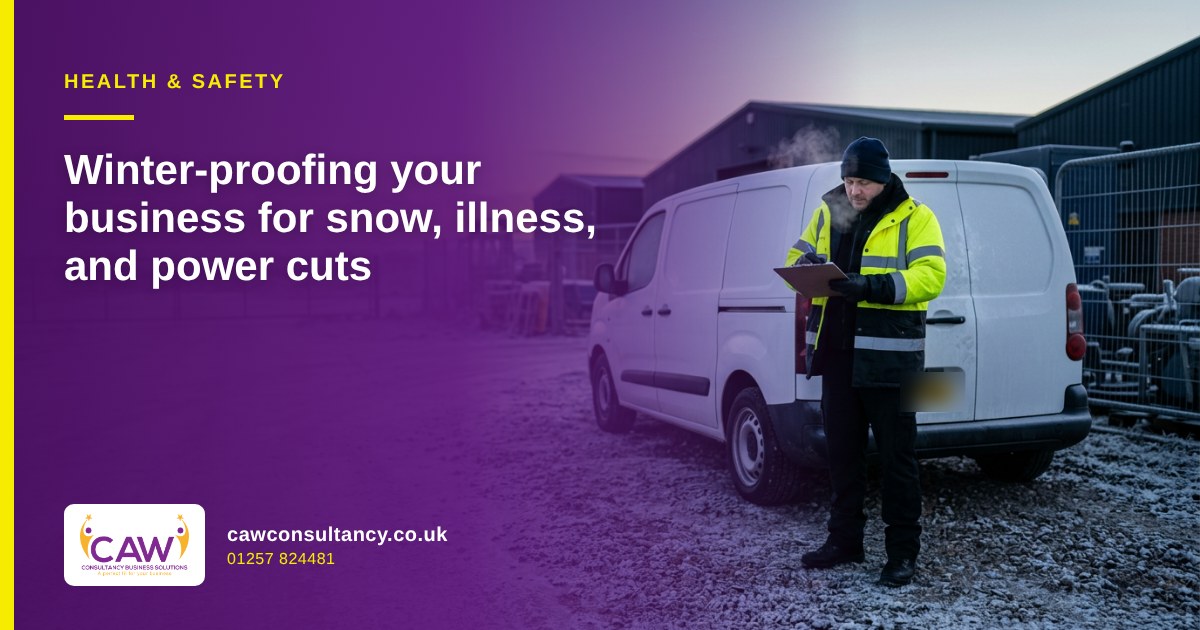
Winter rarely brings one big disaster. It brings lots of small ones at the same time. A cold snap closes a depot, three staff call in sick in the same week, a guard can’t get to a remote site because the roads are iced, and a power cut takes out the office server just as the rota needs updating.
None of that is unusual, and most of it is predictable. That’s the point of planning. In this guide I’ll cover the legal basics for working in the cold, how to manage drivers and lone workers when the weather turns, how to cope with staff illness, and how to plan for power cuts, with a practical checklist at the end. I’ll also explain where ISO 22301 fits in if you want to take business continuity further.
Keeping workplaces warm enough
The legal starting point is regulation 7 of the Workplace (Health, Safety and Welfare) Regulations 1992, which says that “during working hours, the temperature in all workplaces inside buildings shall be reasonable.”
What counts as reasonable? HSE’s workplace temperature guidance says the minimum temperature in an indoor workplace should normally be at least 16°C, or 13°C if much of the work involves rigorous physical effort. HSE’s Approved Code of Practice for the Workplace Regulations (L24) carries the same figures. HSE also points out that there’s no law for a maximum working temperature.
In practice, the places I see problems in winter are warehouses, gatehouses, security huts, welfare cabins on construction sites, and offices where the heating is on a timer that doesn’t match shift patterns. A night officer arriving at 6pm to a cabin that’s been unheated all day is a common example. Check thermostats, timers, and portable heater arrangements now, and remember that portable heaters bring their own fire and electrical risks, so they belong in your risk assessment too.
Outdoor work is different. The 16°C figure applies to indoor workplaces, so for outdoor roles such as patrols, car park duties, and site security, your controls are things like suitable clothing, access to warm welfare facilities, hot drinks, and sensible break patterns. Write these down in the risk assessment rather than leaving them to individual supervisors.
Driving at work when the weather turns
HSE’s driving at work guidance is clear that “health and safety law applies to work activities on the road in the same way as it does on a fixed site”, and that the main areas your risk assessment should look at are the journey, the driver or rider, and the vehicle.
HSE’s guidance on planning and managing journeys is particularly relevant in winter. It says vehicles “should be properly equipped to operate in poor weather conditions such as snow, ice and high winds”, and tells employers: “Don’t pressure drivers and riders to complete journeys where weather conditions are exceptionally difficult.” It also asks you to “support drivers and riders if they need to cancel a journey because of the weather conditions.”
That has real implications for mobile patrol, key holding, and alarm response services, where there’s contractual pressure to attend. Agree in advance with clients what happens when travel isn’t safe, and make sure your staff know they won’t be penalised for making a sensible call.
The Met Office issues yellow, amber, and red warnings through the National Severe Weather Warning Service, covering up to seven days ahead for rain, thunderstorms, wind, snow, lightning, ice, extreme heat, and fog. A simple rule set linked to those warnings (“amber snow warning means the duty manager reviews all non-urgent journeys”) takes the guesswork out of decisions on the day.
Lone workers in winter
Many security and cleaning roles involve lone working, and winter adds to the risk. Darkness comes earlier, slips on ice are more likely, and a breakdown on a rural road is more serious at minus three than in July.
HSE’s lone working guidance says that “as an employer, you must manage any health and safety risks before people can work alone”, and that employers must make sure employees get immediate help if taken ill or injured at work. For winter, that means checking your welfare check-in system works, that lone workers have charged phones and a way to raise an alarm, and that someone actually responds if a check-in is missed.
Our guide to risk assessments that actually work is a good starting point if your lone working assessment hasn’t been looked at since last year.
Planning for staff illness
Winter illness hits small teams hardest. If two of your five supervisors are off at once, rotas, client communication, and on-site supervision all suffer.
A few things help. Make sure more than one person can do each critical task (rota planning, payroll, client reporting, alarm response coordination). Keep a list of relief staff and their training and licence status. And make sure your sickness absence procedure is up to date: since 6 April 2026, the government’s Employment Rights Act timeline confirms that the Statutory Sick Pay Lower Earnings Limit and waiting period have been removed, which may affect how you budget for winter absence.
Power cuts and IT failures
If you lose power, what stops? For most SMEs it’s the internet connection, phones, the server or shared drive, card payments, door access, and CCTV. For a security company running a control room, it’s far more serious.
The UK Government’s Prepare site gives 105 as the number to report a power cut and suggests writing key numbers down on paper. That second point is more useful than it sounds. If your client contacts, staff numbers, and emergency procedures only exist on a computer, they’re not much use in a power cut.
Think about battery backup for critical equipment, mobile data as a fallback for internet access, cloud backups you can reach from a phone, and a printed copy of your continuity plan and key contacts.
Where ISO 22301 fits in
If you want a structured approach, ISO 22301:2019 is the international standard for business continuity management systems. It gives you a framework for working out which activities matter most, how quickly you need them back, and what you’ll do when something disrupts them.
In 2024 ISO published Amendment 1 to ISO 22301:2019, titled “Climate action changes”. It’s one of a set of amendments made across ISO management system standards. According to the joint IAF and ISO communiqué, the climate amendments add a requirement that “the organization shall determine whether climate change is a relevant issue”, and a note that relevant interested parties can have requirements related to climate change. For a continuity plan, that’s a sensible prompt to think about whether more frequent severe weather is a real risk to your operations. ISO also lists ISO 22301:2019 as due to be revised, so keep an eye out for a new edition.
You don’t need certification to benefit from the thinking behind it. Our post on ISO 22301 in plain English explains the basics.
Your winter-proofing checklist
- Check heating, thermostats, and timers in every indoor workplace, including gatehouses and site cabins.
- Review risk assessments for outdoor work, lone working, and driving with winter conditions in mind.
- Agree with clients what happens when travel to site isn’t safe.
- Sign up for Met Office weather warnings and decide in advance what each warning level means for your business.
- Check vehicles are equipped for winter conditions.
- Test your lone worker check-in system, including what happens when a check-in is missed.
- Make sure critical tasks can be covered by more than one person.
- Update your relief staff list with training and licence status.
- Print key contacts and your continuity plan, and keep copies off site.
- Test your backups and your plan for working without mains power.
FAQs
What is the minimum legal temperature for a workplace in the UK?
The law says indoor workplace temperatures must be “reasonable”. HSE guidance says this should normally be at least 16°C, or 13°C if much of the work involves rigorous physical effort.
Is there a maximum workplace temperature?
No. HSE says there’s no law for a maximum working temperature, because every workplace is different.
Can staff refuse to drive in snow?
HSE guidance tells employers not to pressure drivers to complete journeys where weather conditions are exceptionally difficult, and to support them if they need to cancel a journey because of the weather. Build this into your driving policy.
What number do I call in a power cut?
The UK Government’s Prepare site gives 105 as the number to report a power cut.
What is ISO 22301?
ISO 22301:2019 is the international standard for business continuity management systems. Amendment 1:2024 added a requirement to determine whether climate change is a relevant issue.
Get your winter plans in order
If you’d like help reviewing your risk assessments, building a business continuity plan, or preparing for ISO 22301 or ISO 45001 certification, CAW Consultancy can help. Call 01257 824481, email Craig@cawconsultancy.co.uk, or visit www.cawconsultancy.co.uk.
If you’d rather keep your risk assessments, plans, and records in one paperless system you can reach from your phone when the power’s out, CAW Digital builds bespoke paperless management systems. Find out more at cawdigital.org.
Sources
- legislation.gov.uk: Workplace (Health, Safety and Welfare) Regulations 1992, regulation 7
- HSE: Temperature in the workplace
- HSE: L24 Workplace health, safety and welfare. Approved Code of Practice and guidance
- HSE: Driving and riding safely for work
- HSE: Driving and riding safely for work: plan and manage journeys
- HSE: Lone working
- Met Office: Weather warnings guide
- UK Government: Prepare
- ISO: ISO 22301:2019
- ISO and IAF joint communiqué on climate change amendments (February 2024)
Craig Willetts is the founder of CAW Consultancy Business Solutions Ltd and a UK lead auditor with over 20 years’ experience across ISO management systems and UK security industry schemes.


Leave a Reply