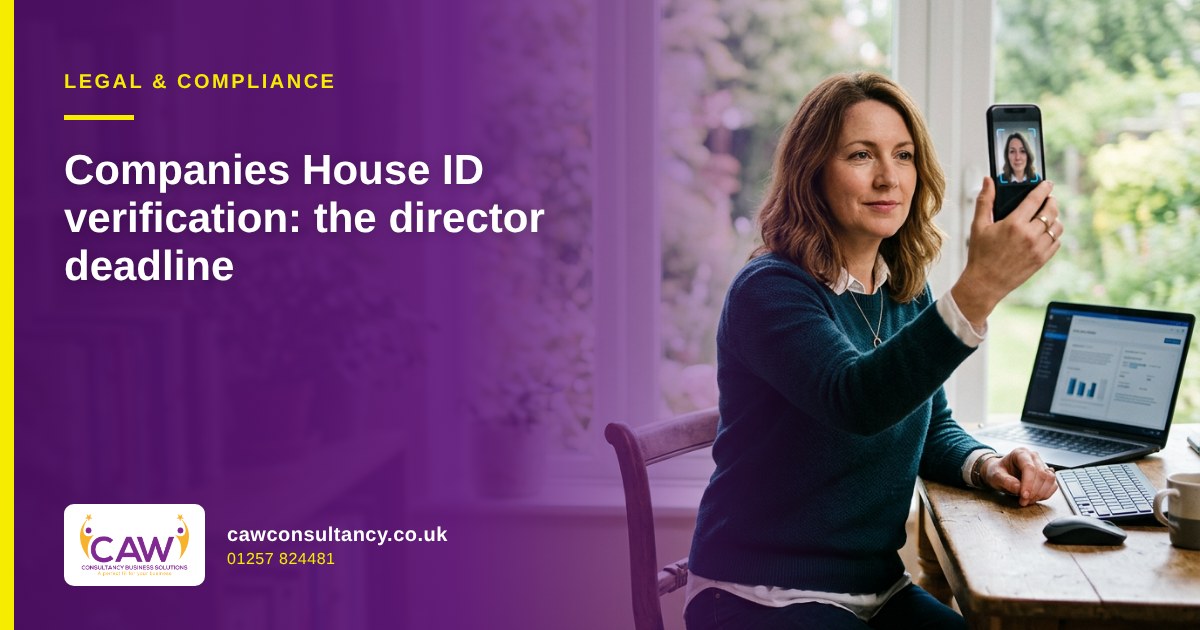
If you’re a company director in the UK, there’s a legal requirement you can’t opt out of and may already be overdue on: verifying your identity with Companies House. The 12-month transition period for existing directors and people with significant control (PSCs) ends on 17 November 2026.
Whether you’re reading this a week before that date or a week after, the action is the same. If you haven’t verified, do it now. This guide explains who needs to verify, by when, how to do it, and what happens if you don’t, using only what Companies House and GOV.UK have published.
What changed and when
Identity verification became a legal requirement on 18 November 2025, under the Economic Crime and Corporate Transparency Act 2023. Since that date:
- Newly appointed directors must verify before acting as a director, and registering a new company requires the personal code for each director.
- Existing directors (appointed before 18 November 2025) and existing PSCs were given a transition period to verify.
Companies House was clear that 18 November 2025 was “not a deadline” but the start of a 12-month transition period. The transitional regulations define that period as the 12 months beginning with 18 November 2025, so it runs to 17 November 2026. When the scheme was announced, Companies House estimated that 6 to 7 million individuals would need to verify by mid-November 2026.
You’ll see 18 November 2026 quoted in some places. The legal wording (“12 months beginning with 18th November 2025”) means the last day of the transition is 17 November 2026. Don’t plan around the later date.
When existing directors must verify
This is where most people get confused. Your personal deadline isn’t simply 17 November 2026. It’s your company’s next confirmation statement filed during the transition period.
GOV.UK’s guidance says you’ll need to provide your Companies House personal code as part of your company’s next confirmation statement. GOV.UK says every company must file at least one confirmation statement every 12 months, so for most existing directors the deadline falls somewhere in the 12-month transition. If your company’s confirmation statement date was in, say, March 2026, your deadline has already passed. The transitional regulations also cover companies that don’t file a confirmation statement during the transition: the identity verification is then due with the company’s next confirmation statement, so a late filing doesn’t get anyone off the hook.
If you’re a director of several companies, you verify once, but your code has to be provided for each company, at each company’s confirmation statement.
When PSCs must verify
People with significant control have their own timetable, set out in the Companies House blog on PSC verification:
- If you’re a PSC but not a director, you must provide your personal code within the first 14 days of your birth month. If your birthday is in November, your window is 1 to 14 November 2026.
- If you’re both a director and a PSC of the same company, you provide your code separately for each role. As a director, it goes in the confirmation statement. As a PSC, you have a 14-day period starting the day after the company’s confirmation statement date.
If you became a PSC after 18 November 2025, you can provide your code when you’re added to the register, or within 14 days of being added.
Filing the confirmation statement early doesn’t change your PSC dates. Companies House says you can request a 14-day extension through its online service, but you must do so before your deadline passes.
How to verify
There are two routes, and both give you the same result.
Directly with Companies House using GOV.UK One Login
This is free of charge. You may be asked to verify using an app, answer security questions online, or enter your photo ID details and then complete the check in person at a participating Post Office.
Through an Authorised Corporate Service Provider (ACSP)
An ACSP is an authorised agent, such as an accountant or solicitor, registered with Companies House. They check your identity using documents from an approved list. They may charge a fee.
Your personal code
Once verified, you get a Companies House personal code. It’s 11 characters long, personal to you rather than to any company, and you keep the same code for every role you hold. You’ll need it whenever you file as a director or PSC. If you’ve lost it and verified through GOV.UK One Login, sign in to Companies House and go to “Manage account”. If you used an ACSP, check the email address you gave them. If you think your code has been compromised, contact Companies House for a new one.
What happens if you don’t verify
GOV.UK is direct about this. If you don’t comply with identity verification requirements on time, you’ll be committing an offence. According to Companies House and GOV.UK:
- You may face prosecution and a fine through the courts, or a financial penalty.
- It’s an offence to act as a director without being verified once the director duties apply to you.
- You won’t be able to make filings for your company or start a new company.
- Companies House may publish a note against your name on the public register, and you may be unable to become a director of a company, register a new company, or register as an ACSP.
This isn’t theoretical. In September 2026 the Insolvency Service announced its first prosecutions for identity verification offences, with three directors fined at City of London Magistrates’ Court. Two had acted as directors while unverified and signed company accounts. The third director had verified, but was prosecuted for failing to take reasonable steps to stop a co-director acting while unverified. All three were also convicted over late confirmation statements.
That third case is the one I’d want every board to notice. Being verified yourself isn’t enough if you know a fellow director hasn’t done it.
If you’ve missed your date
If your deadline has passed and you haven’t verified, don’t wait for a letter. Verify straight away, make sure your personal code reaches the right filing, and check your company’s confirmation statement is up to date. Every director and PSC on your register should be checked, not just you. Directors who keep acting without verifying, in the Insolvency Service’s words, “risk investigation and prosecution.”
A practical checklist for every company
- List every director and PSC on your company’s register.
- Confirm who has verified and record each person’s personal code securely.
- Note your company’s next confirmation statement date and every PSC’s birth month.
- Make sure anyone not yet verified does it now, through GOV.UK One Login or an ACSP.
- Add identity verification to your onboarding process for new directors.
If you run a management system, this is a legal requirement worth adding to your legal register and reviewing at your next management review. It also fits naturally alongside the other people checks covered in my guide to right to work checks.
FAQs
When is the Companies House identity verification deadline?
For existing directors, it’s your company’s next confirmation statement filed during the transition period. The transition is the 12 months beginning with 18 November 2025, so it ends on 17 November 2026.
Is the deadline 17 or 18 November 2026?
The transitional regulations define the period as “the period of 12 months beginning with 18th November 2025”. That makes 17 November 2026 the last day.
Does it cost anything to verify my identity?
Verifying through GOV.UK One Login is free. An Authorised Corporate Service Provider may charge a fee.
What is a Companies House personal code?
An 11-character code you receive once you’ve verified your identity. It’s personal to you and you use the same code for every company and role you hold.
When do PSCs need to verify?
PSCs who aren’t directors must provide their personal code within the first 14 days of their birth month. PSCs who are also directors have 14 days starting the day after the company’s confirmation statement date.
What happens if I don’t verify my identity?
You commit an offence and may face prosecution and a fine, or a financial penalty. You also won’t be able to make filings for your company or start a new company.
Need help keeping on top of compliance?
Companies House verification is a personal legal duty, so we can’t do it for you, but at CAW Consultancy we help businesses build legal registers and compliance processes so deadlines like this don’t slip through. Our gap analysis is free. Compliance Master can also help you track key compliance dates in one place.
Call 01257 824481, email Craig@cawconsultancy.co.uk, or visit www.cawconsultancy.co.uk.
Sources
- GOV.UK: When you need to verify your identity for Companies House
- GOV.UK: Verifying your identity for Companies House
- GOV.UK: Confirmation statement
- GOV.UK: Companies House personal codes for identity verification
- Companies House blog: Understanding identity verification for PSCs
- GOV.UK: Companies House confirms identity verification rollout from 18 November 2025
- Changes to UK company law: Identity verification
- GOV.UK: Directors warned to verify identities following first Insolvency Service prosecutions
- legislation.gov.uk: The Economic Crime and Corporate Transparency Act 2023 (Commencement No. 6 and Transitional Provisions) Regulations 2025
Craig Willetts is the founder of CAW Consultancy Business Solutions Ltd and a UK lead auditor with over 20 years’ experience across ISO management systems and UK security industry schemes.


Leave a Reply