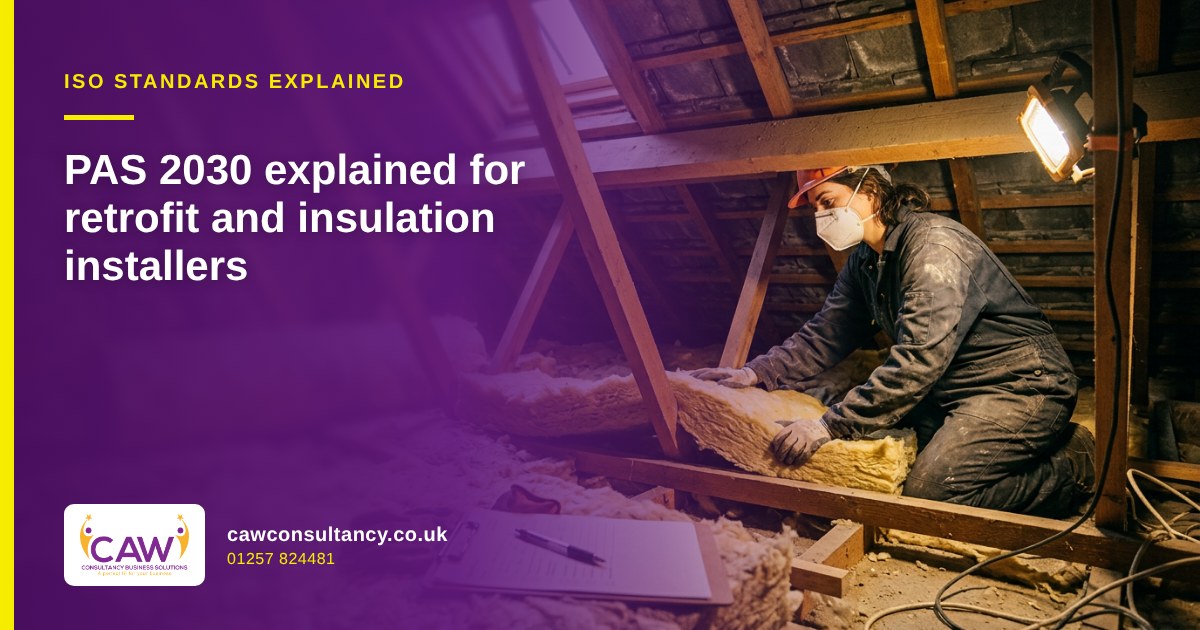
If you install insulation, heating controls, windows, or other energy efficiency measures in people’s homes, and you want work through government-funded schemes, PAS 2030 is the standard that decides whether you’re allowed through the door. It isn’t an ISO standard, and it doesn’t work quite like one, but if you’ve been through ISO 9001 you’ll recognise a lot of it.
This guide explains what PAS 2030 is, how it fits with PAS 2035 and TrustMark, who actually needs it, what the certification assessment looks like, and the gaps I see most often when installers prepare for it.
What PAS 2030 is
A PAS (Publicly Available Specification) is published by BSI. The current edition is PAS 2030:2023, Installation of energy efficiency measures in existing dwellings. Specification. BSI’s own description is that it “specifies requirements for the installation of energy efficiency measures (EEM) in existing dwellings.”
In practice it covers how you plan and manage installations, the methods, tools, and equipment you use, whether the products and materials are suitable, how measures are commissioned, and the training and qualifications of the people doing the work. It also expects you to think about how your measure works alongside other measures in the same home.
It applies to existing homes only. New build and non-domestic buildings are outside its scope.
According to BSI, the 2023 edition came into effect on 30 March 2025, and the previous version (PAS 2030:2019+A1:2022) was withdrawn on the same date. If your documents still reference the 2019 edition, that’s the first thing to fix.
How PAS 2030 and PAS 2035 fit together
The two documents are designed to be used together. PAS 2035:2023, Retrofitting dwellings for improved energy efficiency. Specification and guidance, covers the whole retrofit process: assessing the home, designing the work, coordinating it, and evaluating it. PAS 2030 covers the installation part.
A simple way to think about it: PAS 2035 is the project, PAS 2030 is the installer’s part of it. A Retrofit Coordinator manages the PAS 2035 process, and the installer works to PAS 2030 within it. BSI notes that the 2023 update clarified the Retrofit Coordinator’s role, including site visits and recording non-compliance, and shifted the emphasis from single measures towards a whole-dwelling approach.
One detail installers often miss: PAS 2030:2023 requires your claim of compliance to be supported by a declaration of conformity issued to the client and to the Retrofit Coordinator.
Who needs PAS 2030
You need it if you want to install energy efficiency measures under government-funded schemes. TrustMark states that PAS 2030 is the standard installers must be certified to, and compliant with, when carrying out energy efficiency measures under government initiatives such as ECO. For low-carbon heating such as heat pumps, the relevant certification is MCS rather than PAS 2030.
Registration with TrustMark, the government endorsed quality scheme, is the other half. Ofgem’s supply chain guidance for the Energy Company Obligation states that all installers must be a TrustMark registered business, with a narrow exception for certain district heating connections.
If you only do privately funded work, it’s the funded schemes’ requirement for PAS 2030 that won’t apply to you, although a client or main contractor may still ask for it. Some installers still choose it because it’s the recognised benchmark and opens the door to funded work later.
Where the funded schemes stand in late 2026
This is the area changing fastest, so check before you plan around any scheme:
- The Great British Insulation Scheme ended on 31 March 2026.
- ECO4 has been extended by nine months and now ends on 31 December 2026. The government has said there will be no successor obligation to ECO4.
- The government’s Warm Homes Plan sets out £15 billion of public investment to upgrade up to 5 million homes. Two grant programmes, Warm Homes: Local Grant and Warm Homes: Social Housing Fund, provide funding to local authorities and social housing providers to deliver upgrades. Government statistics note that grant funding for both ends in March 2028, and the Warm Homes Plan says the government intends to bring the two together into a single low-income scheme from 2027/28.
- The Warm Homes: Local Grant delivery guidance requires a TrustMark PAS 2035 project to be created in the TrustMark Data Warehouse for each household in an approved batch.
The government has also said it is overhauling the system of standards and consumer protection for energy efficiency work. That means the rules around certification and TrustMark may change, although no dates have been confirmed. I’d treat PAS 2030 and TrustMark as the baseline for now, and keep an eye on DESNZ announcements.
Who certifies you
Certification is carried out by an independent certification body. TrustMark states that installers must be certified by a certification body accredited by UKAS. You can check any certification body’s accreditation on the UKAS website.
UKAS-accredited certification bodies work to ISO/IEC 17065 and to PAS 2031:2019, which sets out how PAS 2030 certification is carried out. UKAS also issued a PAS 2030 scheme update (latest revision February 2026) that tightened the rules for certification bodies, with particular attention on wall insulation.
What the assessment looks like
Based on the UKAS bulletin and PAS 2031, you can expect:
- A new installer to be rated as high risk at the start (unless the certification body documents why a lower rating is justified), which means more scrutiny early on.
- Pre-installation and mid-installation assessments carried out live, on site, at the right stage of the job, rather than only looking at paperwork after the event.
- Surveillance at least once a year from your initial certification date.
- Your risk rating to be updated based on what the certification body finds.
- Nonconformities to be addressed within eight weeks of being identified, with further action (which can include suspension or withdrawal) if they aren’t dealt with.
- No holding certification for the same measure with more than one certification body.
For external wall insulation, the bulletin also requires certification bodies to complete surveillance of a defined proportion of identified installations set by DESNZ and Ofgem.
The practical message: the assessor wants to see real installations, done properly, by competent people, with records that match what’s on site. If you’ve been through the ISO certification process, the rhythm will feel familiar, but there’s far more emphasis on site work.
Common gaps I see
These are the areas where installers most often fall short when preparing for PAS 2030:
- Documents still referencing PAS 2030:2019 rather than the 2023 edition.
- Competence records that don’t show each installer is trained and qualified for each specific measure they install.
- No clear evidence that products and systems are suitable for the property they’re going into.
- Commissioning and handover records that are incomplete, or completed by someone who wasn’t on site.
- No declaration of conformity issued to the client and the Retrofit Coordinator.
- Weak control of subcontractors, with no records showing their competence or checks on their work.
- Complaints and remedial work not recorded or not followed through.
- Photos and site records that don’t clearly show the stages an assessor needs to see.
Most of these come down to the same thing a good ISO 9001 system delivers: clear processes, the right records, and someone checking them. If you already hold ISO 9001, a lot of your framework can be reused.
FAQs
What is the current version of PAS 2030?
PAS 2030:2023. BSI states it came into effect on 30 March 2025, when the previous PAS 2030:2019+A1:2022 was withdrawn.
What is the difference between PAS 2030 and PAS 2035?
PAS 2035 covers the whole retrofit process for a home, including assessment, design, coordination, and evaluation. PAS 2030 covers the installation of the energy efficiency measures within that process.
Do I need PAS 2030 to install a heat pump?
For heat pumps and other low-carbon heating, TrustMark says installers must be certified under MCS. PAS 2030 applies to energy efficiency measures such as insulation.
Do I need TrustMark as well as PAS 2030?
For government-funded schemes, yes. Ofgem’s ECO guidance states that all installers must be a TrustMark registered business, and Warm Homes: Local Grant projects are lodged in the TrustMark Data Warehouse.
Who issues PAS 2030 certification?
A certification body accredited by UKAS. Consultants can prepare you, but they can’t certify you.
Is ECO4 still running?
ECO4 has been extended to 31 December 2026, and the government has said there will be no successor obligation. The Great British Insulation Scheme ended on 31 March 2026.
Getting ready for PAS 2030 with CAW Consultancy
At CAW Consultancy we help installers build the procedures, competence records, and site documentation PAS 2030 expects, and we carry out internal audits so you know where you stand before the certification body visits. We don’t certify; your independent, UKAS-accredited certification body does that. Our gap analysis is free, and internal audits are £399 + VAT.
If you’d rather run everything on a tablet than in folders, CAW Digital builds bespoke paperless management systems, which suits installers capturing photos and records on site.
Call 01257 824481, email Craig@cawconsultancy.co.uk, or visit www.cawconsultancy.co.uk.
Sources
- BSI: PAS 2030:2023
- BSI: PAS 2035:2023
- BSI: PAS 2030:2023 preview document
- TrustMark: Support for gaining PAS and MCS certification
- Ofgem: Energy Company Obligation supply chain
- DESNZ: Extending the ECO4 end date, government response
- GOV.UK: Warm Homes Plan
- GOV.UK: Warm Homes: Local Grant and Warm Homes: Social Housing Fund statistics, methodology and background note
- DESNZ: Warm Homes: Local Grant delivery guidance
- UKAS: PAS 2030 scheme update
Craig Willetts is the founder of CAW Consultancy Business Solutions Ltd and a UK lead auditor with over 20 years’ experience across ISO management systems and UK security industry schemes.


Leave a Reply