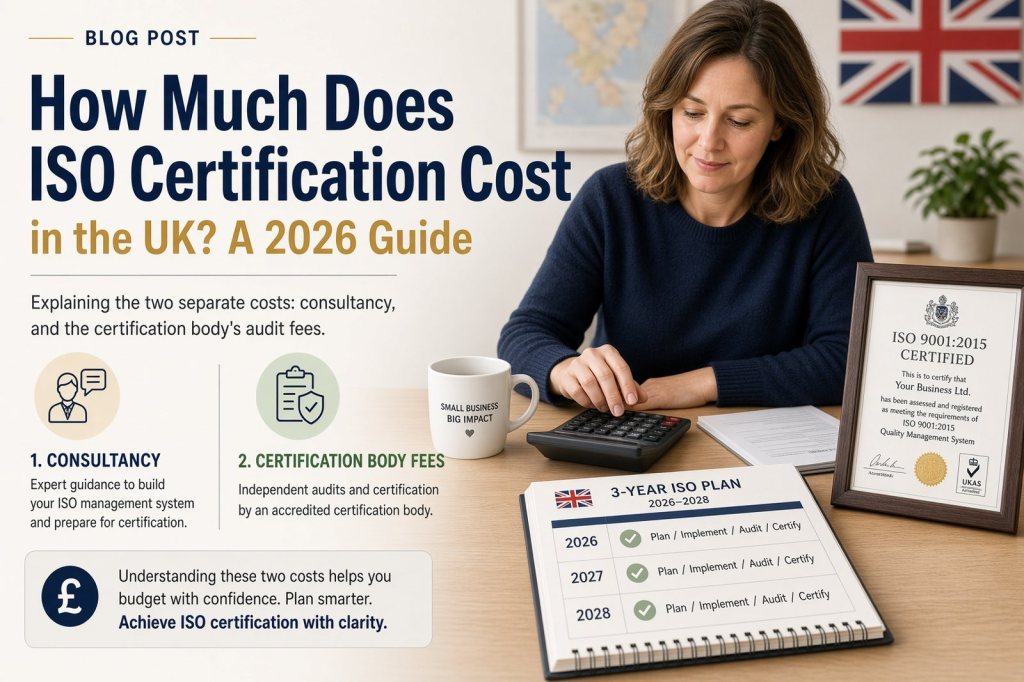
“How much will it cost?” is usually the first question I’m asked, and it’s a fair one. The short answer is that ISO certification cost in the UK is made up of two separate things: what you spend getting ready (which may include a consultant) and what you pay a certification body to audit you and issue the certificate. Many businesses budget for one and get caught out by the other.
In this guide I’ll break down both, explain what pushes the audit fee up or down, set out the ongoing costs across the three-year certification cycle, and share practical ways to keep the total sensible.
The two costs that make up ISO certification
1. Consultancy (optional)
You don’t have to use a consultant. Some organisations build their own management system in-house. Most smaller businesses, though, find that expert help costs less than the staff time it takes to learn a standard from scratch and get it wrong first time.
At CAW Consultancy, our packages are (consultancy only, ex VAT):
- From £999 for a single standard, such as ISO 9001
- From £1,399 for two standards
- From £1,799 for three standards (a tri-standard system, such as ISO 9001, ISO 14001 and ISO 45001)
- Other accreditations from £300, with CHAS, SafeContractor and Constructionline support at £399
These fees cover building and supporting your system. They do not include the certification audit, which you pay separately to the certification body.
2. The certification body’s audit fees
The certificate itself is issued by a certification body after an independent audit. ISO doesn’t certify anyone – it states plainly that it does not perform certification or issue certificates – and neither does a consultancy like ours.
As a guide, external certification audit fees start from £595 with a non-UKAS-accredited certification body and from £1,500 with a UKAS-accredited one. Where your quote lands above those starting points depends on the factors below.
What drives ISO certification cost in the UK?
Accredited certification bodies don’t pick an audit length out of thin air. For ISO 9001, ISO 14001 and ISO 45001, they must follow international rules on audit time. For years these were published as IAF MD 5. Since the International Accreditation Forum’s work was brought together with ILAC’s under the new Global Accreditation Cooperation (Global ACI) on 1 January 2026, the same rules have been reissued as Global ACI-TECH-3-004, which applies from 28 August 2026.
In my experience, the number of audit days is the biggest single driver of the fee. Here’s what decides it.
Number of people (“effective personnel”)
The starting point is the effective number of personnel: everyone involved within the scope of certification, including permanent, temporary and part-time staff and those working on each shift. Contractors are included where they fall within the scope. More people generally means more audit time.
Complexity and risk
Your activities are placed in a complexity or risk category. For quality, that reflects the consequences of a product or service failing; for environmental, the nature of your environmental aspects; for health and safety, the nature and severity of your risks. A high-risk operation needs more audit time than a low-risk, office-based service.
Number of sites
Complicated logistics across more than one building or location can add audit time. Organisations with several sites are covered by a separate set of multi-site rules.
Other adjustments
The rules list factors that increase time, such as a high degree of regulation or highly complex processes, and factors that reduce it, such as a mature management system or the certification body already knowing your system because it certifies you to another standard. Reductions can’t exceed 30% of the time set by the rules’ audit-time tables.
How many standards you certify to
Each extra standard adds audit time. However, if you run a fully integrated management system, the certification body can audit it as one. Under the integrated audit rules (formerly IAF MD 11, now Global ACI-TECH-3-008), the starting point is the sum of the audit times for each standard. Integration can reduce that by up to 20%, although a complex integrated audit can also take longer.
The ongoing costs: your three-year certification cycle
Certification isn’t a one-off purchase. Under ISO/IEC 17021-1, the international standard that certification bodies work to, the cycle looks like this:
- Initial certification audit in two stages: Stage 1 (a documentation and readiness review) and Stage 2 (an assessment of how well your system is implemented and working).
- Surveillance audits at least once every calendar year, except in recertification years. The first must take place no more than 12 months after the certification decision.
- Recertification audit in the third year, planned so that renewal can be completed before your certificate expires.
Under the audit time rules, the total time spent on surveillance each year is about a third of the initial audit time, and a recertification audit is normally about two thirds of it. So you will pay an audit fee every year. When you compare quotes, ask each certification body to price the full three-year cycle, not just year one.
There’s also a cost to letting things slide. If the certification body can’t verify the correction of major nonconformities within six months of the last day of Stage 2, it must carry out another Stage 2 before recommending certification. And if your certificate expires, it can only be restored within six months if the outstanding recertification activities are completed; otherwise at least a Stage 2 is needed. Either way, that’s extra audit time on your bill.
The hidden cost: your own team’s time
The figures above are what you pay out. For many SMEs the bigger cost is internal time:
- Managers agreeing scope, policy, objectives and risks
- Staff learning new procedures and keeping records
- Carrying out internal audits and a management review before Stage 2
- Being available on the audit days
- Investigating and closing out any nonconformities
A system that fits how you already work takes far less effort to run than a generic template nobody follows.
UKAS-accredited vs non-accredited certification
What accreditation means
UKAS is the UK’s national accreditation body, appointed under the Accreditation Regulations 2009. UKAS doesn’t certify businesses to ISO 9001 or other management system standards. Instead, it assesses certification bodies against ISO/IEC 17021-1 to confirm they are competent and impartial – in effect, “checking the checkers”. A UKAS-accredited certification body has been independently assessed; a non-accredited one hasn’t.
Accreditation is voluntary. In many sectors there’s no legal requirement to hold accredited certification.
Why buyers and tenders often ask for it
In my experience, many buyers, particularly in the public sector, security and construction, specify accredited certification in pre-qualification questionnaires and tenders. The international accreditation community notes that accredited certification is increasingly a requirement of specifiers in both the public and private sectors, and accredited certificates are recognised internationally through the accreditation bodies’ mutual recognition arrangements.
If you’re certifying mainly to win contracts, check the buyer’s wording before you choose. A cheaper certificate that a buyer won’t accept is not a saving.
How to check a certificate or certification body
- UKAS website: search for accredited certification bodies and check the body’s schedule of accreditation covers your standard and your industry sector.
- UKAS CertCheck: a free tool for verifying claims of UKAS-accredited certification.
- IAF CertSearch: an international database of accredited management system certificates. Uploading certificates is voluntary for certification bodies, so if a certificate isn’t listed, confirm it directly with the certification body.
New editions in 2026: does that affect cost?
ISO 14001:2026 was published on 15 April 2026 and ISO 9001:2026 on 16 September 2026. UKAS has set deadlines for accredited certification bodies to move all their certified clients to the new editions: 30 April 2029 for ISO 14001 and 30 September 2029 for ISO 9001. ISO 45001:2018 and ISO/IEC 27001:2022 remain the current editions, although ISO 45001 is being revised.
If you’re already certified, ask your certification body how and when it will transition you, and whether that adds audit time. If you’re starting now and want UKAS-accredited certification to ISO 9001:2026, check the certification body has received its UKAS transition decision. Until it has, UKAS says any ISO 9001:2026 certificate that body issues must not be presented as accredited.
How to keep ISO certification costs down
- Get the scope right. Your scope decides which people, sites and activities are audited, so make it accurate: not inflated, and not artificially narrow.
- Integrate where you can. If you need two or three standards, an integrated system audited together can reduce audit time compared with separate audits.
- Compare like with like. Check what your customers require, then get quotes for the full three-year cycle from more than one certification body, for the same standards, scope and accreditation status.
- Be ready for Stage 1. Having your internal audit, management review and records in place helps you avoid extra visits.
- Keep the system running all year. Surveillance audits are far easier when the system is used every day rather than dusted off once a year.
- Build it right first time. Fixing nonconformities later usually costs more than getting the system right at the start.
Frequently asked questions
How much does ISO 9001 certification cost in the UK?
There are two parts. Consultancy is optional: CAW Consultancy’s packages start from £999 ex VAT for a single standard such as ISO 9001. The certification body’s audit fee is separate and, as a guide, starts from £595 with a non-UKAS-accredited body and from £1,500 with a UKAS-accredited one. Your final figure depends on headcount, risk, number of sites and scope.
Is the certification fee a one-off cost?
No. Certification runs on a three-year cycle. After the initial Stage 1 and Stage 2 audits, you’ll have surveillance audits at least once a calendar year, then a recertification audit before your certificate expires in year three. Budget for an audit fee every year, and ask certification bodies to quote for the whole cycle so you can compare properly.
Do I have to use a UKAS-accredited certification body?
Accreditation is voluntary, and in many sectors there’s no legal requirement for it. However, many buyers and tenders ask for accredited certification because it shows the certification body has been independently assessed as competent and impartial. Check your customers’ requirements first: if they specify accredited certification, a non-accredited certificate may not be accepted.
Is it cheaper to certify to several standards at once?
It can be. Each standard adds audit time, but if you run a fully integrated management system, the certification body can audit it as one, and the rules allow up to a 20% reduction from the combined time for the separate standards. Consultancy is also better value per standard: CAW’s tri-standard package starts from £1,799 ex VAT.
How do I check if an ISO certificate is genuine?
Ask for the certification body’s name and the certificate number. For UKAS-accredited certification, use UKAS CertCheck or search the UKAS website to confirm the certification body is accredited for that standard. IAF CertSearch lets you search accredited certificates internationally. If a certificate isn’t listed, contact the certification body directly to confirm it is valid.
Get a clear quote from CAW Consultancy
If you want to know exactly what certification will cost your business, talk to us. CAW Consultancy prepares organisations for certification; your chosen certification body carries out the audit and issues the certificate.
Since 2011 we’ve supported thousands of organisations across more than 20 standards. We build systems within 48 hours and typically deliver them within 72, at around 50% lower cost than the sector average, with a 100% audit pass rate over 20+ years, including UKAS-accredited audits.
Call 01257 824481 or visit www.cawconsultancy.co.uk for a clear, no-obligation quote.
Getting certified, or keeping it running
CAW Consultancy builds your management system, prepares you for audit and supports you through certification across 20+ ISO standards, from £999 ex VAT for a single standard.
Prefer to run it in-house? The ISO Training Institute has self-paced courses with a month of phone and email support afterwards, plus free starter courses. And if you want the whole system paperless, CAW Digital builds it into a digital platform for £999 flat.


Leave a Reply