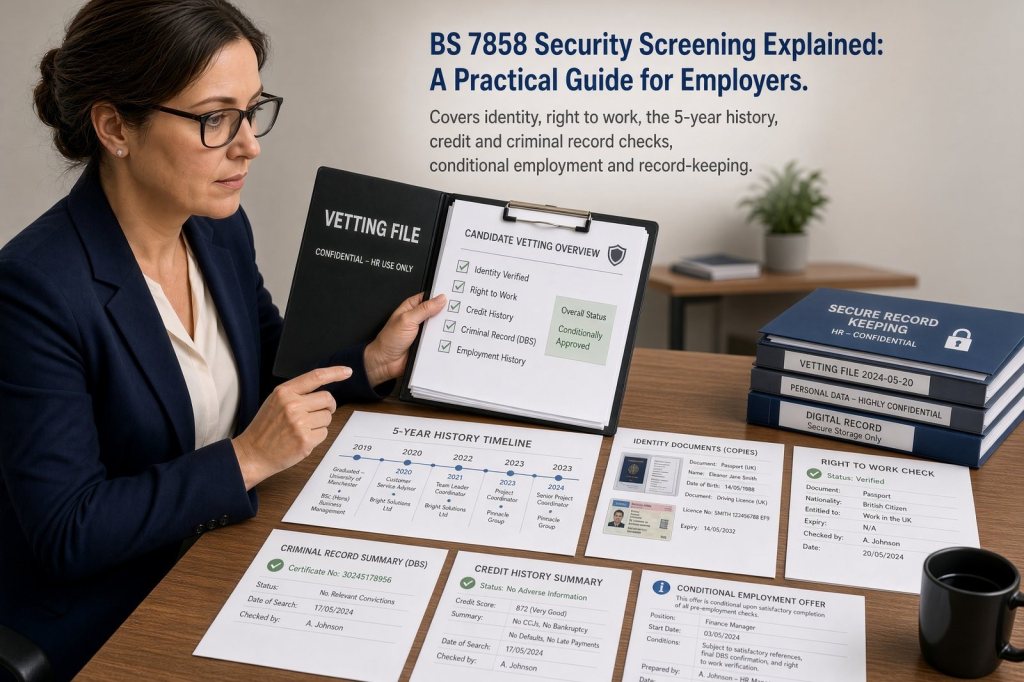
If you employ people in security, or in any role where someone on the inside could cause real harm, BS 7858 screening is the benchmark that buyers, auditors and, for approved contractors, the Security Industry Authority (SIA) expect you to follow. Get it wrong and it is one of the quickest ways to pick up a nonconformity, lose a contract or put an unsuitable person on site.
I have worked in the security industry for over 20 years, and around 60% of our clients at CAW Consultancy are security businesses, so I see a lot of screening files. This guide explains what the standard asks for, how the timescales work and where employers most often trip up.
What is BS 7858?
BS 7858 is a British Standard code of practice published by BSI. Its full title is Screening of individuals working in a secure environment. Code of practice. The current edition is BS 7858:2019, which came into effect on 30 September 2019 and replaced BS 7858:2012. At the time of writing, BSI still lists the 2019 edition as current.
BSI defines a “secure environment” broadly: anywhere an insider could steal or threaten the integrity of data, information or other assets, or threaten people’s safety.
Because it is a code of practice, the standard is written as recommendations rather than legal duties. In practice, though, if your contracts, your certification scheme or the SIA’s Approved Contractor Scheme (ACS) expect BS 7858, an auditor will treat those recommendations as requirements.
The 2019 edition widened the scope beyond security, put more emphasis on risk assessment and top management, and made clear that organisations stay accountable for any screening they outsource.
Who needs BS 7858 screening?
The standard grew up in the security sector, and that is still where you see it most:
- Security companies – guarding, door supervision, CCTV, key holding, cash and valuables in transit, close protection and security systems.
- SIA approved contractors – SIA guidance makes clear that approved contractors’ pre-employment screening must conform to BS 7858, and that outsourcing your screening does not outsource your responsibility.
- Organisations outside security – BSI’s own summary lists facilities management, HR departments, retail, sports and entertainment, and local government among its users.
It applies to everyone in relevant employment: full-time, part-time, temporary and permanent staff, sole traders, partnerships and all levels of seniority, including directors. Decide and document which support roles, such as administration, maintenance and cleaning, fall within your scope.
What BS 7858 screening covers
The aim is to gather enough verified information to make an informed employment decision. A compliant screening file covers the following areas.
Identity and address
Identity is verified using the Disclosure and Barring Service (DBS) Group A and Group B document lists, preferably including photographic ID. Inspect the original documents, check them for signs of tampering and keep a copy. Current address is confirmed too. If the candidate already holds an SIA licence, check it against the SIA’s public register.
Right to work in the UK
This element is a legal duty in its own right. Home Office guidance says you must carry out a right to work check before the person starts work, using a manual document check, a Home Office online check or a Right to Work digital verification service provider. Keep copies securely for the duration of employment and for two years afterwards.
The stakes are high. The Home Office code of practice sets civil penalties of up to £45,000 per illegal worker for a first breach and up to £60,000 per worker for repeat breaches. From 1 October 2026, the Right to Work Scheme also covers people engaged on a worker’s contract, individual sub-contractors and online matching services.
Employment, education and gap history
This is the heart of BS 7858 screening. You need a continuous record of the person’s career and history across the screening period, with no unverified gaps of more than 31 days. That means confirming employment, education, self-employment, unemployment, time abroad and career breaks, not just jobs.
Written confirmation from employers is the starting point, and you should only contact a current employer with the candidate’s written permission. Where an employer has closed or will not respond, documentary evidence such as payslips, a P45 or a P60 can help. Verify that emailed references really came from the employer. A statutory declaration is a last resort, with strict limits and prior approval from top management.
Financial checks
BS 7858 expects a check of public record information through a credit reference agency, covering things like county court judgments, bankruptcy, the electoral roll and linked addresses. It also expects checks against sanctions, watchlist and fraud databases. Certain findings, such as significant county court judgments, a bankruptcy or other directorships, need documented risk acceptance by top management or an authorised person, rather than an automatic rejection.
Criminal record checks
The standard accepts one of three routes: an SIA licence for the appropriate sector, a police letter under the NPCC Security Systems Policy, or a criminal record disclosure from the appropriate government body. For most non-SIA roles, that means a basic check from DBS in England and Wales, Disclosure Scotland or AccessNI. A basic DBS check only shows convictions that are not spent.
The Information Commissioner’s Office (ICO) says you should only obtain criminal records disclosure for the person you intend to appoint, so run it at offer stage, not on every applicant.
What is no longer required
Character references were removed in the 2019 edition. Social media and open-source checks are mentioned but are not a requirement, and the ICO expects any you do carry out to be justified and explained to candidates.
The BS 7858 screening period and timescales
The standard screening period is five years, with ten-year screening used where a contract or industry requirement calls for it.
You don’t have to wait for full screening before someone starts. BS 7858 allows conditional employment once the preliminary checks are done. These include opening the screening file, reviewing the application information, verifying identity and address, and completing the public record and watchlist checks. Your legal right to work check must also be complete before they start. Full screening should then be finished:
- within 12 weeks of conditional employment starting, for five-year screening
- within 16 weeks, for ten-year screening
A case can be extended by up to four weeks, subject to evidence and top management approval. Track these deadlines from day one, because conditional employment that drifts past them is a common audit finding.
Record-keeping and data protection
Each person should have a screening file with a progress sheet showing what was checked, when and by whom, and the final decision signed off. Under the 2019 edition, core records such as proof of identity, verification of career history and the progress sheet should be kept for seven years after employment ends. The file of anyone unsuccessful at preliminary screening should be kept for at least 12 months.
Screening is also personal data processing, and criminal record information gets extra protection under data protection law. ICO guidance on pre-employment vetting says you should:
- tell candidates before you vet them what you will check and why
- only vet where there is a legal obligation or a significant and particular risk
- have a valid condition under the Data Protection Act 2018 for processing criminal offence data
- securely destroy detailed vetting information, particularly criminal record details, as soon as reasonably practicable
The ICO notes that this guidance is under review following the Data (Use and Access) Act 2025, so watch for updates. The practical answer is a written retention schedule that separates what BS 7858 recommends you keep from sensitive detail you should not hold for longer than necessary, such as recording a criminal record check’s outcome rather than keeping the certificate.
Common BS 7858 screening mistakes
- Starting someone before the preliminary checks and right to work check are complete.
- Gaps of more than 31 days left unverified, or “explained” only by the candidate’s word.
- Accepting emailed references without checking where they came from.
- Conditional employment running past 12 (or 16) weeks with no approved extension.
- No top management sign-off on risk decisions, such as adverse financial findings.
- Outsourcing screening and assuming the provider now carries the responsibility.
- Forgetting directors, or office and control room staff who fall within scope.
- Keeping everything forever, or shredding files the standard says you should keep.
In my experience as a lead auditor, most screening nonconformities are not about unsuitable people slipping through. They are about files that cannot prove what was done.
How to manage BS 7858 screening efficiently
- Write a short procedure. Set out your scope, screening period, risk acceptance rules and retention schedule.
- Use a standard progress sheet. Anyone should see a file’s status at a glance.
- Give candidates a clear pack on day one. List the documents and full history you need. In my experience, incomplete histories cause more delays than anything else.
- Track deadlines. Log each conditional employment start date and its 12-week deadline.
- Audit any outsourced provider. SIA guidance expects approved contractors to request the screening file, check how electronic references were verified and confirm the provider’s BS 7858 competence.
- Include screening in your internal audits. Sample a few files each year.
If you would rather hand over the legwork, CAW provides BS 7858:2019 employee screening through our screening arm, Screen My Staff. It costs £70 per candidate for SIA licence holders and £99 per candidate for non-SIA roles, with a typical turnaround of 10–15 working days. You remain accountable for the final employment decision, as the standard requires.
Frequently asked questions
What is BS 7858 screening?
BS 7858 screening is pre-employment vetting carried out in line with BS 7858:2019, the British Standard code of practice for screening individuals working in a secure environment. It verifies identity, right to work, a continuous career and history over the screening period, financial background and criminal record, so an employer can make an informed decision about someone working in a security-sensitive role.
How long does BS 7858 screening take?
It depends on how quickly employers and other sources respond. Someone can start in conditional employment once the preliminary checks are complete, but five-year screening should be finished within 12 weeks of that start (16 weeks for ten-year screening), with up to four weeks’ extension in justified cases. Our typical turnaround is 10–15 working days.
Is BS 7858 a legal requirement?
No. BS 7858 is a British Standard code of practice, not legislation. However, the SIA expects approved contractors’ screening to conform to it, and it is often written into security contracts and certification schemes. Some elements, such as right to work checks and data protection compliance, are legal duties in their own right.
Can someone start work before BS 7858 screening is complete?
Yes, in conditional employment. The preliminary checks, including identity, address, public record and watchlist checks, must be done first, and you must complete a legal right to work check before they start. Full screening should then be finished within the standard’s time limits.
How long should we keep BS 7858 screening records?
The 2019 edition recommends keeping core records, such as proof of identity, career history verification and the progress sheet, for seven years after employment ends, and files for people unsuccessful at preliminary screening for at least 12 months. Right to work copies must be kept for two years after employment ends. Destroy sensitive vetting detail as soon as practicable.
Talk to CAW Consultancy about BS 7858 screening
Whether you need a screening procedure written, an existing process audited or candidates screened for you, we can help. CAW Consultancy has supported organisations since 2011, and screening sits naturally alongside our SIA, NSI and ISO work.
Call us on 01257 824481 or visit www.cawconsultancy.co.uk to talk it through.
Help with screening and wellbeing
Screen My Staff carries out BS 7858:2019 screening for you: £70 per SIA licence holder and £99 for other roles, typically within 10 to 15 working days. It also offers workplace wellbeing support aligned with ISO 45003 guidance.
Prefer to screen in-house? The ISO Training Institute’s BS 7858 screening course is £99 and self-paced.


Leave a Reply